GREENEVA Shares Strategic Perspectives to Strengthen Central Java’s Disaster and Climate Resilience Roadmap 2025–2045
22 July 2026 | By. Greeneva
Climate change is no longer a challenge confined to the future—it is already shaping regional development today. Increasing hydrometeorological disasters, shifting rainfall patterns, rising temperatures, and growing threats to food security, water resources, and infrastructure require local governments to develop policies that not only respond to current conditions but also anticipate future climate risks.
In line with Indonesia’s commitment to strengthening subnational climate action, the government continues to advance regional climate planning as part of achieving its national greenhouse gas (GHG) emission reduction targets. Following the issuance of the Minister of Environment/Environmental Control Agency Decree No. 1871 of 2026 on the Subnational Roadmap for Nationally Determined Contribution (NDC) Targets, the Directorate of Climate Change Mitigation conducted a series of visits across Java from 13–18 July 2026 to review the progress of provincial GHG Emission Reduction Roadmaps.
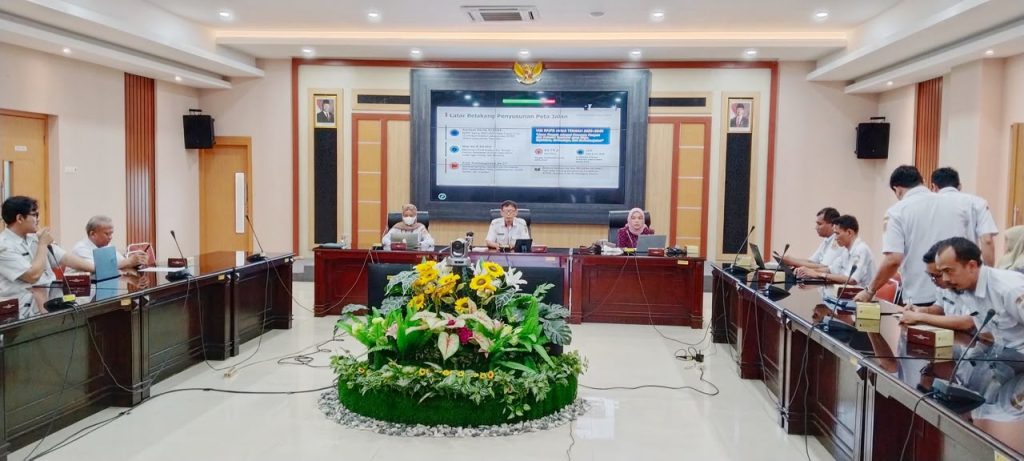
As part of this broader initiative, Central Java hosted the Public Consultation on the Central Java Disaster and Climate Resilience Roadmap 2025–2045 on 15 July 2026. The consultation served as a collaborative platform to gather feedback on policy directions, strategic priorities, targets, and action plans for strengthening regional resilience. Representatives from government agencies, academia, development partners, the private sector, and civil society organizations participated in refining the roadmap.
During the consultation, Ir. Ratna Budiarti, Director of GREENEVA, was invited as a speaker to share strategic perspectives on developing a roadmap that is risk-informed, integrated with regional planning systems, and capable of supporting low-carbon and climate-resilient development.
Building a Climate Risk-Informed and Integrated Roadmap
One of GREENEVA’s key messages was the need to shift the planning paradigm from focusing solely on present-day conditions toward incorporating future climate risks into development planning. As climate change is projected to alter both the frequency and intensity of climate-related hazards, the roadmap should utilize climate projections as an evidence base for identifying risks, setting development priorities, designing implementation strategies, and establishing measurable indicators. This approach enables the roadmap to address current challenges while remaining adaptive to evolving climate risks.
GREENEVA also emphasized the importance of establishing a strong evidence base by integrating disaster risk assessments, climate projections, greenhouse gas inventories, and existing planning documents into a unified decision-making framework. Such an approach supports more consistent, measurable, and long-term policy development while ensuring that planning decisions are grounded in robust scientific evidence.

Beyond evidence-based planning, GREENEVA highlighted the importance of integration across sectors and policy agendas. Climate mitigation, climate adaptation, disaster risk reduction, and land subsidence risk management should not be treated as separate initiatives. Instead, they need to be addressed through a unified policy framework that maximizes co-benefits, simultaneously reducing emissions while strengthening the resilience of communities, infrastructure, and ecosystems.
Another key recommendation focused on strengthening the relationship between the roadmap and the regional planning system. Rather than functioning as a standalone document, the roadmap should be aligned with existing planning instruments through a shared baseline, harmonized targets and indicators, risk-based prioritization, and an integrated monitoring and evaluation system. This ensures that the roadmap serves not only as a strategic policy document but also as an effective and implementable guide for regional development.
Advancing Low-Carbon and Climate-Resilient Development
GREENEVA also shared its perspective on advancing low-carbon development beyond the establishment of emission reduction targets. The roadmap should function as an implementation framework that connects policy development, greenhouse gas inventories, Monitoring, Reporting, and Verification (MRV) systems, and mitigation actions across priority sectors. In the long term, this integrated approach is expected to support the transition toward a low-carbon society by embedding low-carbon principles into regional development planning.
At the same time, climate adaptation should be positioned as an integral component of regional development. Success should not be measured solely by the number of adaptation programs implemented, but by their ability to reduce vulnerability and strengthen the adaptive capacity of communities and regions. Integrating climate risks into spatial planning, infrastructure development, regional investment, and sectoral policies will be essential to ensuring that development remains resilient under future climate conditions.
The public consultation provided an important platform for collaboration among multiple stakeholders to strengthen the roadmap and ensure that it responds comprehensively to regional development challenges. Through the exchange of knowledge and perspectives from government institutions, academia, the private sector, civil society organizations, and development partners, the roadmap is expected to become not only aligned with national policy directions but also practical, implementable, and responsive to local needs.
For GREENEVA, building climate-resilient regions begins not merely with preparing planning documents, but with providing reliable data, strategic perspectives, and meaningful collaboration to support evidence-based decision-making. Through technical assistance, policy studies, and strategic engagement, GREENEVA remains committed to supporting the development of policies that address climate challenges while advancing low-carbon, resilient, and sustainable regional development.