GREENEVA Goes to Campus: Bridging Academic Knowledge and Real-World Work Experience
30 September 2026 | By. Greeneva
Entering the professional world after completing higher education is a new stage that often comes with many questions. What knowledge will be applied? What skills need to be developed? And what kind of working environment will graduates encounter beyond the university setting?
These questions are becoming increasingly relevant as the world of work continues to evolve. Technological developments, changing industry needs, new ways of working, and growing attention to environmental and sustainability issues are shaping the competencies expected of today’s professionals.
Academic knowledge remains an important foundation. However, the ability to apply that knowledge, adapt to professional needs, communicate effectively, collaborate across disciplines, and continuously learn is equally important when entering the workplace.
This is also evident in the environmental field. Growing attention to climate change, resource management, environmental compliance, sustainable development, and Environmental, Social, and Governance (ESG) is expanding the need for environmental perspectives across different sectors. Contributing to sustainability does not necessarily mean working in a profession explicitly labelled as “environmental.”
Green Career: Contributing to Sustainability Without Changing Your Field
The term green career is often associated with professions directly related to the environment or sustainability. However, contributions to sustainability can take place across a wide range of professions and sectors.
Professionals can bring sustainability perspectives into their respective fields through decision-making, data management, product development, process efficiency, planning, communication, and many other roles.
Building a green career, therefore, does not necessarily mean changing the field one has studied. It can also mean recognising existing skills, understanding the evolving needs of the workplace, and finding ways to connect those competencies with real-world challenges.
For students preparing to enter the professional world, this perspective can help broaden the way they view career opportunities. Career paths do not always follow a linear trajectory based on one’s academic major or first job. Experiences, skills, and learning can continue to evolve throughout a professional journey.
GREENEVA Goes to Campus
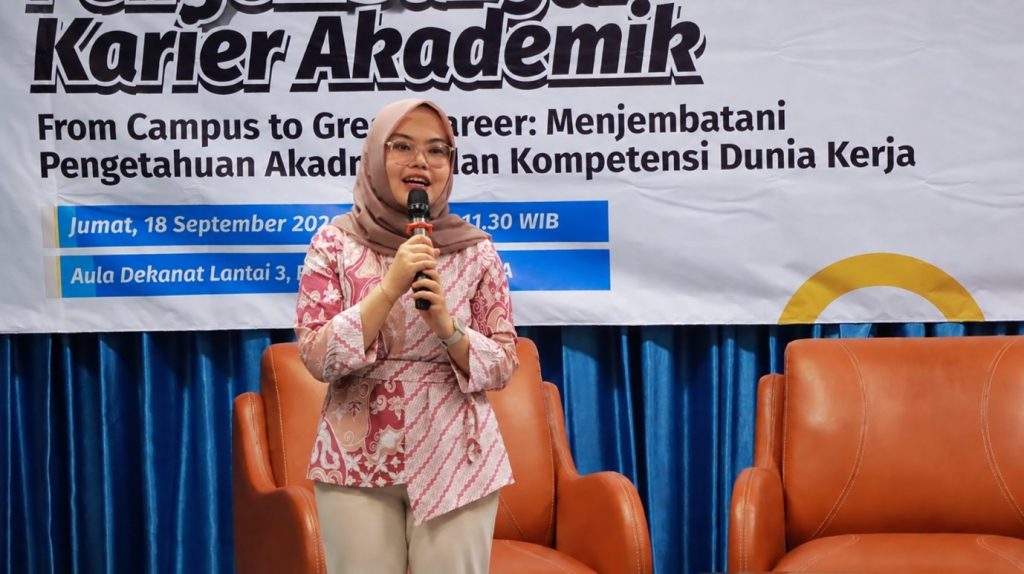
Sharing perspectives on the professional world and the journey toward a green career was part of GREENEVA’s involvement in the Academic Career Development Workshop for FMIPA UNNES Graduates, Period 142, organised by the Faculty of Mathematics and Natural Sciences, Universitas Negeri Semarang (UNNES), on Friday, 19 September 2026.
With the theme “From Campus to Green Career: Bridging Academic Knowledge and Workplace Competencies,” the workshop provided a space for academics and professionals to share perspectives on the transition from university to the professional world.
As one of the speakers, Cintiya Egi Purwadi, S.Ling., Environmental Technical Staff at PT Green Environesia Cendekia, shared her experience of transitioning from academic life into the professional world, particularly through her work in environmental consulting.
The discussion was not limited to career opportunities in the environmental field. It also explored how knowledge gained during university can be applied in professional settings. Experiences in data processing and analysis, understanding regulations, preparing environmental studies, and communicating with different stakeholders are among the competencies that continue to develop as professionals enter and navigate the workplace.
The session also highlighted that professional journeys do not always follow a single path. Everyone may have a different trajectory, discover areas of interest through experience, and develop their competencies as their roles and professional environments evolve.
Connecting Campus and the Professional World
The connection between higher education and the professional world is important in helping students understand that career readiness is not only about obtaining a degree, but also about continuously developing and applying knowledge and skills.
Engaging with practitioners can provide insights into workplace dynamics that may not always be visible within the university environment. At the same time, conversations with students provide professionals with an opportunity to hear the perspectives of the generation that will soon become part of the evolving workforce.
For GREENEVA, engagement with the academic community is part of its effort to connect knowledge with real-world application. In line with the spirit of “Turning Knowledge into Sustainable Action,” GREENEVA views knowledge not only as something to be developed and shared, but also as a foundation for creating actions and solutions that contribute to environmental and societal well-being.
This commitment is also reflected in GREENEVA’s continued collaboration with universities and academic communities. Knowledge exchange between academia and the professional world creates opportunities to bring together research, practical experience, and real-world needs.
Through these collaborations, GREENEVA not only shares practical experiences from the workplace, but also continues to learn from scientific developments and research emerging from academic communities. This two-way relationship is an important part of supporting more applicable approaches to environmental management and sustainability.
The Academic Career Development Workshop for FMIPA UNNES Graduates, Period 142, became one of the spaces through which GREENEVA carried this spirit forward—sharing experiences, exchanging perspectives, and connecting academic knowledge with the realities of the professional world.
Ultimately, the journey from campus to green career is not about finding a single “greenest” profession. It is about how each individual can bring their knowledge, competencies, and sustainability perspectives into the work they choose to pursue.
Because knowledge becomes even more meaningful when it can be translated into action for a more sustainable future.